Sunday, 1 May 2016

Black Snake Millipede

A second find from today, an interesting Black Snake Millipede (Tachypodoiulus Niger)

Book's description:

Black snake millipede Tachypodoiulus niger

Like centipedes, millipedes dwell in the moist, dark world of
leaf litter and soil. The two are often confused, but there is a
clear point of distinction-millipedes have two pairs of legs on
each body segment; centipedes only have one pair. Britain has
50 species of millipede, of which the black snake millipede is one
of the most common. All species consist of many segments
protected by a hard plate that forms their outer skeleton. The
skeleton gives protection from predators, particularly when the
millipede curls up into a flat ball to conceal its soft underparts.
As it rolls up it can produce a foul-smelling liquid or vapour
from glands along its sides.
    Millipedes feed mainly on soft plant tissue, either living or
dead. In attacking root crops and young plants they are agricul-
tural pests, but they are beneficial to soil fertility by recycling
dead and decaying leaves. Young millipedes, which hatch from
eggs, are tiny copies of their parents, and the three to six
months to mature. An adult millipede may live for several years.
    The pill millipede is a squat, shiny species which can roll up
into a complete ball when threatened, leaving no chinks in its
armour. It is similar to the pill bug woodlouse.

Black Snake Millipede
Photo by Alex Sidney

Black Snake Millipede
Photo by Alex Sidney

Black Snake Millipede
Photo by Alex Sidney

Garlic Glass Snail

Sorry I haven't been posting very much lately - not much to find yet…. so here is a find from today.

Garlic Glass Snail (Oxychilus Alliarius)

Quoted almost identically from the book:

-----------------------------------------------------------------------------------

Garlic glass snail
Oxychilus alliarius

The narrow, wheel-shaped shell is shiny, translucent and
pale yellow-brown or green. The body is blue-black. The
snail lives on banks, walls, rocks, and in fields and woods
all over Britain. It smells strongly of garlic if it is handled
or disturbed. Shell size up to 1/16 in. (5 mm) wide and 1/4
in. (6 mm) high.

-----------------------------------------------------------------------------------

Here are my photos of it:

Garlic Glass Snail
Photo by Alex Sidney

Garlic Glass Snail
Photo by Alex Sidney

Garlic Glass Snail
Photo by Alex Sidney

Garlic Glass Snail
Photo by Alex Sidney

Saturday, 9 April 2016

Mealworm Beetle

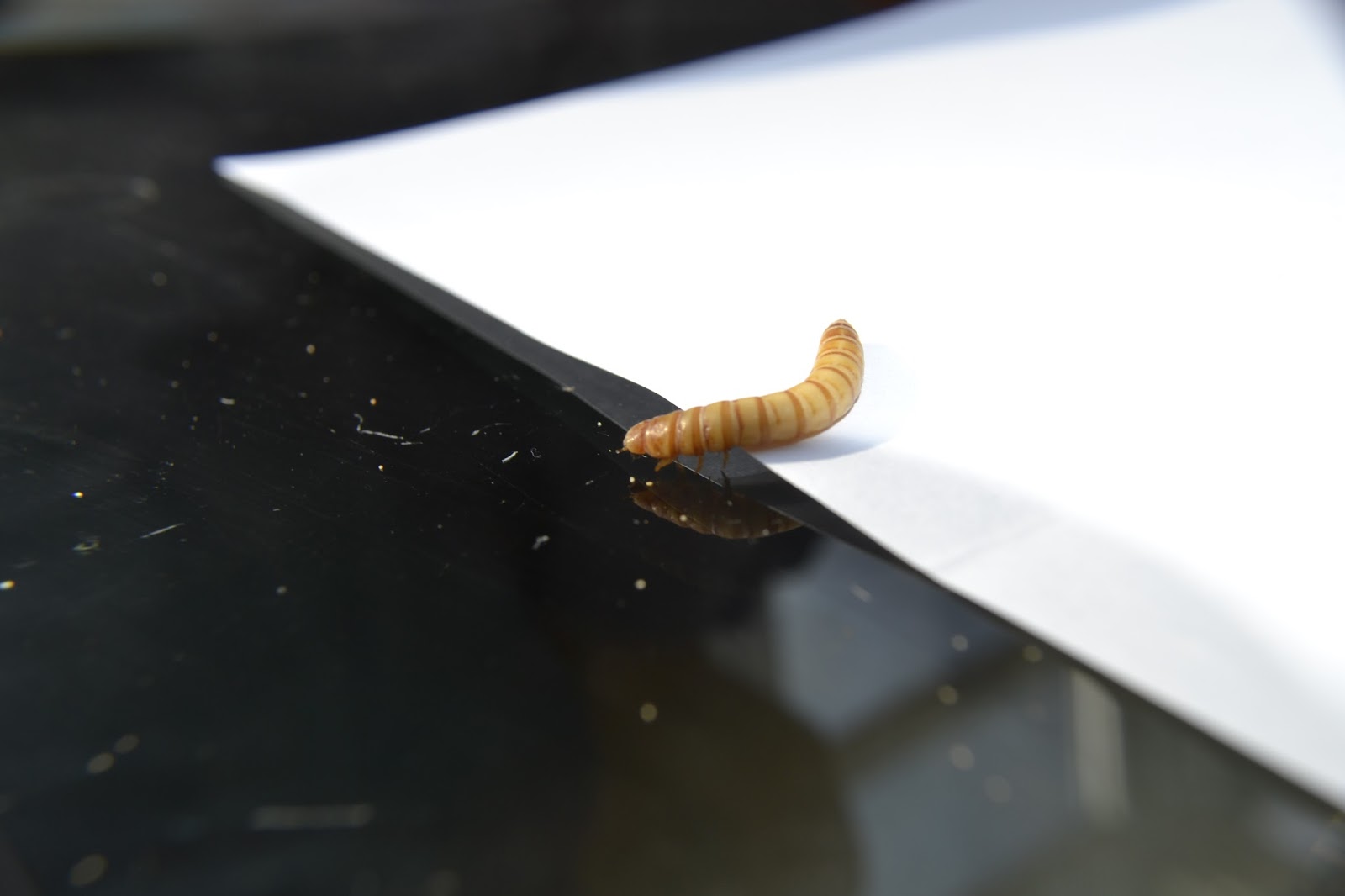
I thought that I'd add a more 'domestic' touch to my finds, though strictly not a find - my Mealworm Beetles (Tenebrio Molitor). The reason that it isn't officially a find, is because I breed them. They are usually used as reptile live-food, or bird feed…. but it still counts for my Challenge.

So, I got one Larva, and one Adult, and convinced my family each to take a few pictures of the Beetle & Mealworm Larva. I told them, as an incentive, that the person who took the best photos would win a prize. The members competing in this 'family photography competition', are Kim, my 8 y.o. little Sister, Franz, my Mum, Clive, my Dad, and Me, but I'm not competing - just taking photos for the enjoyment of it.
So: Here are the pictures:
Clive:
Mealworm Larva
Photo by Clive Sidney

Mealworm Larva
Photo by Clive Sidney

Mealworm Larva
Photo by Clive Sidney

Mealworm Beetle
Photo by Clive Sidney

Mealworm Beetle
Photo by Clive Sidney

Mealworm Beetle
Photo by Clive Sidney

Mealworm Beetle
Photo by Clive Sidney
Franz:
Mealworm Larva
Photo by Franz Sidney


Mealworm Beetle
Photo by Franz Sidney
Kim:
Mealworm Larva
Photo by Kim Sidney

Mealworm Beetle
Photo by Kim Sidney

Mealworm Beetle
Photo by Kim Sidney
Me: (Not included in the competition)
Mealworm Beetle
Photo by Alex Sidney

Mealworm Beetle
Photo by Alex Sidney

Mealworm Larva
Photo by Alex Sidney

Mealworm Larva
Photo by Alex Sidney

Mealworm Larva
Photo by Alex Sidney

Mealworm Larva
Photo by Alex Sidney
Review:

Well, from Clive, I think, he did great side-view close-ups, but not enough detailed above photos.
From Mum, not many photos, simple, yet detailed. Maybe a close-up?
As for Kim, the Larva, wasn't as good as it could have been, too far away, but I loved the close-ups of the beetle - that fact is, she included the whole body so you could see the shape - making it easier for anybody to identify it.

And the winner is...................


Franz Sidney!

Sunday, 3 April 2016

Long Time, No See!

I last posted on this blog in January! Sorry!

I guess that I couldn't really find many creatures on the list, before March or April. Now that the Insects have started appearing more often, I can post on this blog more often!
I tried finding one yesterday, but it turned out to be Galeruca Tanaceti, a species of the Leaf Beetle Family. (It's posted on my other blog, www.animalsandinsectsofnorfolk.blogspot.co.uk)

So I will be posting again soon!

Alex

Friday, 1 January 2016

Common Earthworm

Finally!
My first specimen that's actually on the list! Tried many photos, but none really came out right: that's really the best one.
It's a Common Earthworm, and its scientific name is Lumbricus Terrestris.

Striped Woodlouse

Yay!

My first specimen caught on camera!
One problem though: I went outside, and said to myself that I would post the FIRST species I saw, which happened to be a Woodlouse. After I took all the pictures, I noticed that I didn't even have that species on the list!
So it's still 0 for the list. But at least I got some pictures! The species I am looking for is Oniscus Asellus, commonly known as the Common, or Shiny Woodlouse.
The species I found was Philoscia Muscorum, commonly known as the Striped Woodlouse.


Photo Equipment

So far for photos, I have been using these 3 things:

  • My Phone (Photos)
  • 1 6x Magnifier Hand Lens with LED
  • A yellow lamp
So far I have not been able to get hold of a really good camera, so most of my photos will not be that good.


Yellow Lamp


6x Magnifier Hand Lens with LED